Calculating blocks seems simple: wall area ÷ block area. But between the apparent simplicity and practical accuracy stand two numbers that change the result by as much as a quarter sometimes: the openings that must be subtracted from the area, and the mortar joint that enlarges the effective face area of each block. In this guide we explain the correct method step by step, with a table of blocks per square meter for every size, a full numeric example, and an estimate of the masonry mortar — the same calculations the Adawati Block Calculator performs.
Step one: the net wall area after subtracting openings
Start with the gross area: wall length × its height. Then subtract everything that will not be built with blocks: doors (a standard door is about 1 × 2.1 m = 2.1 m²), windows at their actual sizes, and any openings or protruding column voids per your plan. The result is the net area, and it is the basis of everything that follows. On a facade with a door and two large windows, the openings can reach a quarter of the gross area; whoever skips this step orders a quarter of their need extra and pays its price, its transport and its storage.
Step two: the effective face area with the mortar joint
A block does not sit attached to its neighbor; between them is a mortar joint with a usual thickness of 1 cm horizontally and vertically. So the face area each block "consumes" in the wall is larger than its nominal size:
Effective face area = (block length + 0.01) × (its height + 0.01) — and blocks per square meter = 1 ÷ effective face area.
| Size | Effective face with the joint | Count per square meter |
|---|---|---|
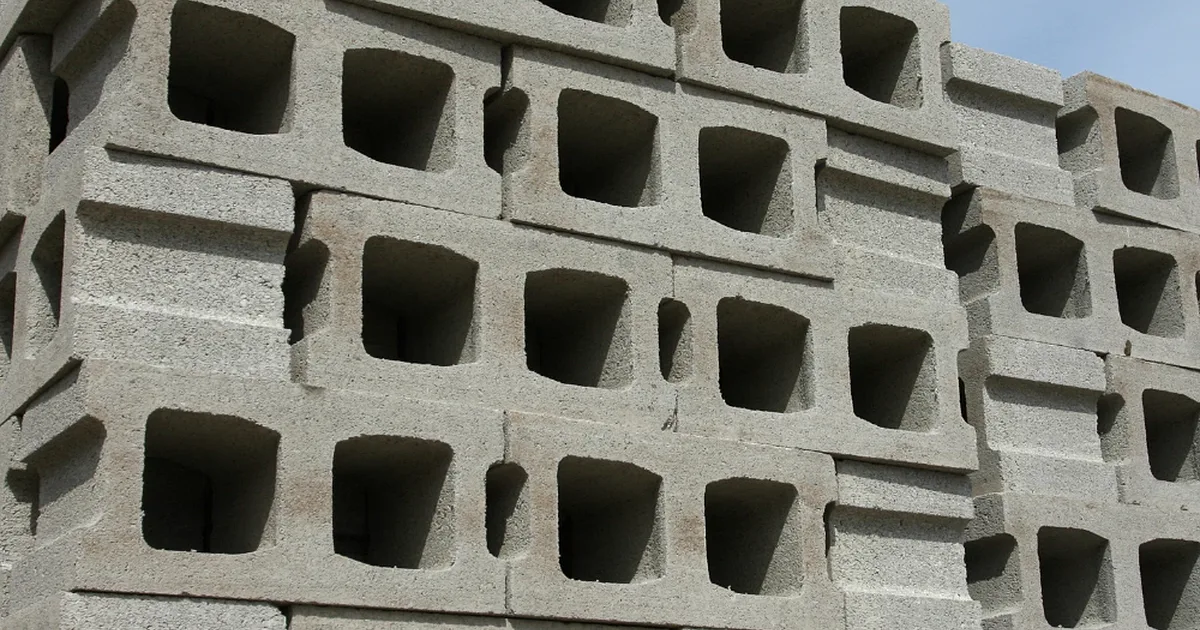
| Concrete block 40×20 cm | 0.41 × 0.21 = 0.0861 m² | ≈ 11.6 blocks |
| Concrete block 30×20 cm | 0.31 × 0.21 = 0.0651 m² | ≈ 15.4 blocks |
| Red brick 25×12 cm | 0.26 × 0.13 = 0.0338 m² | ≈ 29.6 bricks |
Note that the block thickness (20, 15 or 10 cm) does not enter the count calculation at all; the count follows the face alone. Thickness matters in the mortar volume, the wall weight and its suitability for its function, not in the number of pieces.
A full numeric example: a 5 × 3 m wall
An external wall 5 meters long and 3 meters high, with a 2.1 m² door and a 1.5 × 1.5 = 2.25 m² window, and 40×20 cm concrete blocks with a thickness of 20 cm:
- Gross area: 5 × 3 = 15 m².
- Openings: 2.1 + 2.25 = 4.35 m², so the net area = 15 − 4.35 = 10.65 m².
- Net count: 10.65 ÷ 0.0861 = 123.7 → 124 blocks after rounding up.
- With 7% waste: 123.7 × 1.07 = 132.4 → 133 blocks is the purchase quantity.
- Masonry mortar: wall volume = 10.65 × 0.20 = 2.13 m³, and the blocks' own volume = 124 × (0.40 × 0.20 × 0.20) = 1.984 m³, so the wet mortar ≈ 0.146 m³, and its dry volume × 1.3 ≈ 0.19 m³, giving with a 1:4 mix about 1.1 cement bags and 0.15 m³ of sand approximately.
Compare with the result if you ignored the openings and the joint together: 15 ÷ 0.08 = 188 blocks — i.e., 55 extra blocks (41%) beyond the real need in one small wall. Method errors, not arithmetic errors, are what usually inflate block orders.
Estimating masonry mortar: the volumes trick
There is no famous direct equation for mortar, but there is an elegant volume trick that the calculator uses: fill the wall theoretically — its total volume is known (net area × thickness), and the solid block volume is known (count × block dimensions), and the difference between them must be mortar. The result is a wet volume multiplied by 1.3 to convert it to dry materials, as with plaster mortar, then distributed over a 1:4 mix: the cement is one fifth of the dry volume × density 1440 ÷ a 50 kg bag, and the sand is four fifths. Treat the result as an approximate estimate; the regularity of the joints and the block's actual void ratio move it up and down.
The waste percentage: small in number, large in effect
Waste in blocks is not random breakage only; it includes what breaks in transport, unloading and storage, what is cut at wall ends, corners and around openings, and what is damaged during work. The practical range is 5–10%, and the calculator default is 7%. Long, straight walls suffice with the lower percentage, and short walls interrupted by columns and openings deserve the higher. And remember that large offcuts from cutting are often reused in the same course, so do not raise the percentage out of fear without a realistic reason.
Common mistakes when calculating blocks
- Forgetting to subtract openings: the largest source of order inflation, especially on window-dense facades.
- Neglecting the mortar joint: calculating with the nominal size alone overstates the count by about 8%.
- Calculating external walls only: internal partitions with a thickness of 10 or 15 cm are often forgotten although they are full-count walls.
- Forgetting the fence and annexes: they are calculated the same way and added to the project order, not discovered later.
- Removing waste to save: a supplementary order for twenty blocks costs a transport fee and a waiting crew several times their value.
- Mixing two sizes in one order without separating the calculation: calculate each size on its own walls; counts are not added across sizes.
Choosing the block size and thickness: a decision of count and price together
Choosing the size is not a matter of taste; it decides the number of pieces, the building speed, the wall weight and its final price all at once. The large 40×20 block covers the wall with the fewest pieces (about 11.6 per meter), speeding the work and reducing the mortar joints, but it is heavier for the mason and harder to handle on upper floors. The 30×20 block is lighter and easier to cut around openings and corners, in exchange for a larger count (about 15.4 per meter). As for the 25×12 red brick, it consumes about 29.6 bricks per meter — a large count, but with a lighter piece weight and suitability for some traditional building types and partitions. And by thickness: your external and load-bearing walls usually take 20 cm, heavier internal partitions 15 cm, and light ones between rooms 10 cm — but the last word always belongs to your approved plan, because thickness is a structural, thermal and acoustic decision together, not a purchase decision.
And an important price note: compare suppliers by the price per built square meter, not by the price of a single block. A block that is 10% cheaper but has a smaller face may need a larger count by a percentage exceeding the saving, so you lose on the count, the mortar and the masonry labor together. Calculate it this way: block price × its count per square meter (from this guide's table) = the material cost per meter, then add its estimated mortar, and compare the results between sizes and suppliers — one fair comparison instead of scattered impressions.
A word on wall weight and transport to the site
The block count is not the only number that comes out of your calculation; the order's weight determines how many transport trucks you need and how it will be stored on a sometimes tight site. A 40×20×20 cm concrete block weighs roughly between 14 and 18 kg depending on its void ratio and its manufacturer, so our example order (133 blocks) approaches 2.2 tons — one small truck suffices for it, while a full villa order may exceed twenty tons, delivered in batches synchronized with the building progress, not in one batch that blocks the site. Ask your supplier about his block's actual weight and agree with him on a delivery schedule by wall stages; a block stored for weeks in the open absorbs moisture and its edges break with every additional handling, and every block broken from poor storage is waste your percentage did not count.
Conclusion
The correct block count = a net area after subtracting openings ÷ an effective face area that includes a 1 cm mortar joint, then rounding up and adding a realistic waste between 5 and 10%. Apply it to your project's walls, wall by wall, in the Block and Brick Calculator and change the size and thickness to see the effect of every choice on the count and the mortar, then complete your project's picture with Calculating Finishing Quantities, which will cover these walls with plaster and paint.