The question "how much cement, sand and aggregate do I need?" precedes every pour, and its answer passes through three steps that never change, whatever the element: the wet volume from the element's dimensions, then converting it to a dry volume with the 1.54 factor, then distributing the dry volume over the mix ratio you chose. In this guide we explain the three steps with the equations and work a full example for a slab with M20 concrete, using the same numbers the Adawati Concrete Calculator uses.
Step one: the wet volume from the element's dimensions
The wet volume is the final concrete volume that will fill the element after pouring and compaction, and it is calculated from geometry alone:
- Slab, footing and raft: length × width × thickness.
- Column: section width × section depth × height, multiplied by the number of identical columns.
- Beam: width × depth × length.
- Concrete wall: length × height × thickness.
Our example in this guide: a slab of 5 × 4 meters and 0.15 m thickness, so its wet volume = 5 × 4 × 0.15 = 3 m³. Watch the thickness unit: 15 cm is entered as 0.15 m, not 15 — a unit error here multiplies the result a hundredfold.
Step two: from wet to dry — the 1.54 factor
The materials you will buy do not equal 3 m³; cement, sand and aggregate before mixing are loose materials carrying air voids between their particles amounting to roughly a third of their apparent volume. When water is added and the mix is made, the fine particles fill the voids of the coarse ones, then compaction settles the mix and its volume shrinks to the final volume. That is why engineers multiply the wet volume by the dry-volume factor 1.54:
Dry volume = wet volume × 1.54 — for our slab: 3 × 1.54 = 4.62 m³ of dry materials.
This factor is the thing most often forgotten in amateur calculations: whoever orders materials with a volume of 3 m³ for a 3 m³ pour will discover, two-thirds into the pour, that the mixer has stopped and the element is not complete — and pouring an element in two separate batches with a time gap means a cold structural joint in the most dangerous place.
Step three: distributing the dry volume over the mix ratio
There are three common nominal mix ratios, read (cement : sand : aggregate) by volume:
| Mix | Ratio | Sum of parts | Cement per m³ of concrete* | Common use |
|---|---|---|---|---|
| M15 | 1 : 2 : 4 | 7 | ≈ 6.3 bags | Non-structural works and blinding layers |
| M20 | 1 : 1.5 : 3 | 5.5 | ≈ 8.1 bags | Residential slabs, beams and columns |
| M25 | 1 : 1 : 2 | 4 | ≈ 11.1 bags | Elements with higher strength per the design |
* Before adding the waste percentage, and derived from: (1.54 × cement share ÷ sum of parts) × 1440 ÷ 50.
The cement share is converted from volume to weight using the approved cement density of 1440 kg/m³, then to bags by dividing by the standard bag weight of 50 kg. Sand and aggregate, on the other hand, stay in cubic meters, as they are bought.
A full numeric example: a 3 m³ slab with the M20 mix
Let us continue the slab example (3 m³, ratio 1:1.5:3, sum of parts 5.5, dry volume 4.62 m³):
- Cement: 4.62 × (1 ÷ 5.5) = 0.84 m³ × 1440 = 1,209.6 kg ÷ 50 = 24.2 bags.
- Sand: 4.62 × (1.5 ÷ 5.5) = 1.26 m³.
- Aggregate: 4.62 × (3 ÷ 5.5) = 2.52 m³.
- Water: cement weight × water-to-cement ratio 0.50 = 1,209.6 × 0.5 = about 605 liters.
- Estimated rebar: at the slab rate of 80 kg/m³ × 3 = 240 kg as an initial estimate.
Adding 5% waste — the calculator's default percentage — raises the materials to: cement 1,270 kg, i.e., 26 full bags after rounding up, sand 1.32 m³, aggregate 2.65 m³, and water 635 liters (because the water is built on the cement weight after waste). This is the practical purchase list, not the bare equation numbers.
Mixing water: the number destroyed by "a little extra water"
The water-to-cement ratio (w/c) governs the concrete's strength as much as the cement quantity itself. The water chemically required to complete the reaction is less than what is practically used for workability, and every amount of water beyond the mix's need evaporates after setting, leaving pores that weaken the concrete and increase its permeability and shrinkage. So if the mix seems stiff on site, the solution is not the water hose, but reviewing the aggregate grading or using plasticizers under engineering supervision. In your calculations, stick to the ratio approved by your element's design — 0.50 by default in the calculator.
Estimated rebar: approximate rates, not design
For preliminary purchase orders and quote comparisons, approximate rebar rates per cubic meter are used, differing by element, and they are the defaults in the calculator: slabs 80 kg/m³, footings and rafts 50, beams 120, columns 160, and concrete walls 60. These remain planning numbers; the real executive reinforcement comes from the reinforcement schedules in the structural drawings, and you calculate its weight and bars precisely from the Calculating Rebar Weight guide.
Important note: this calculator and this guide estimate quantities using known nominal ratios; they do not design a mix for a targeted strength and do not verify the safety of any structural element. The mix ratio and the required strength for your elements are determined by the structural engineer in your drawings, and any difference between this estimate and your engineer's bill of quantities is always settled in the engineer's favor.
Common mistakes when calculating concrete quantities
- Forgetting the 1.54 factor: you order materials with the same volume as the pour and run out in the middle of it.
- Mixing volumetric and weight ratios: the nominal ratios here are volumetric; whoever weighs sand and aggregate with the same ratio numbers actually changes the mix.
- Entering the thickness in centimeters in a meters equation: check the units before any calculation.
- Buying cement in fractional counts: 24.2 bags means at least 25 bags; a fraction cannot be bought.
- Adding mixing water on site: it destroys the strength you paid for in cement.
- Neglecting sand moisture and bulking: wet sand bulks up, so its volume looks larger, and the water in it adds to the mixing water; account for it at high precision.
Ready-mix or site mixing? How the decision changes your calculation
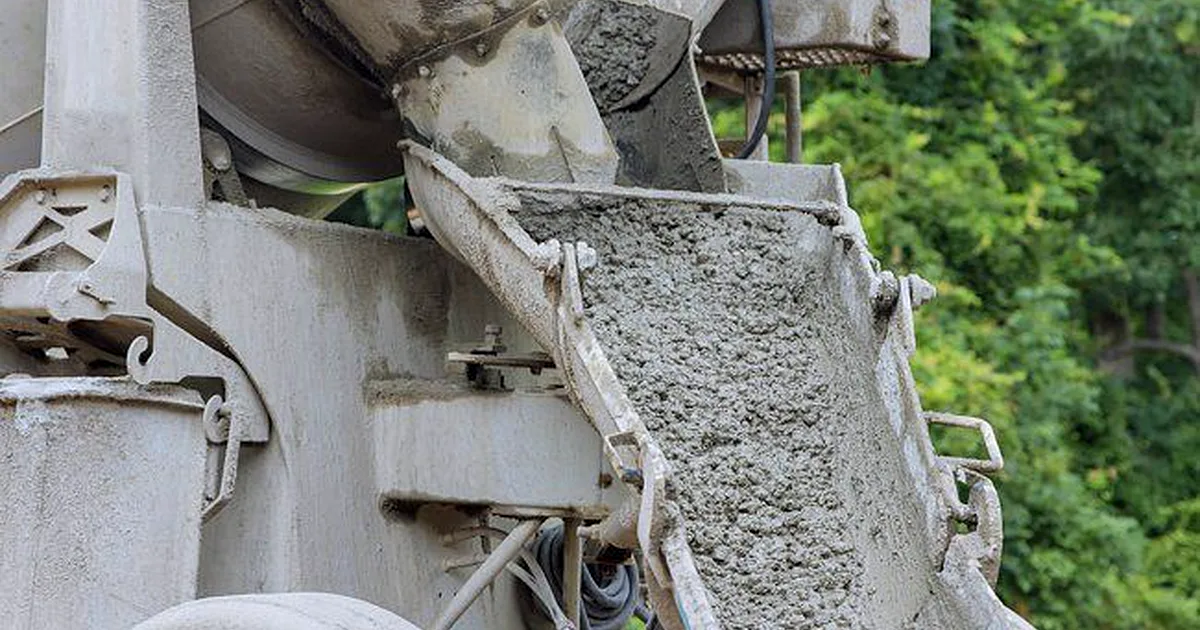
The quantities in this guide — bags, sand, aggregate and water — concern site mixing with an ordinary mixer. But if you pour ready-mix concrete from a plant, your role in the calculation changes radically: you no longer buy the ingredients; you buy a ready wet volume in cubic meters of a specified grade (C20 or C25, for example, per your engineer's specifications). Then only the first step of this guide is enough for you — the element's wet volume — plus a small practical margin for what remains in the pump and the pipes and what spills, then you order the final volume from the plant at the agreed grade and specifications, and the plant takes care of the mix ratios, quality control and water calibration. Site mixing remains a logical economic option for small quantities and scattered elements where a concrete truck and its pump do not justify their cost, while ready-mix excels in large, continuous pours such as roofs and large footings in consistency of quality and speed of execution. In both cases: do not change the water-to-cement ratio yourself in search of easier flow; any extra water lowers the final concrete strength in a way that nothing can repair after hardening.
A quick checklist before pour day
Before you order the materials or book the mixer, go over five points: does the mix grade match the element's specifications in the structural drawing rather than the contractor's habit? Did you add a realistic waste percentage and record it? Will the cement bags be stored dry, raised off the ground, until pour day? Have you prepared clean water suitable for mixing and curing alike, and a curing method (covering and spraying) for the days after the pour? And did you review the calculator's output against at least one contractor's bill of quantities and explain any large difference before buying? Five minutes on this checklist saves mistakes that cannot be fixed after the concrete hardens.
Conclusion
Calculating concrete quantities is a chain of three links: a wet volume from the dimensions, × 1.54 to a dry volume, then distribution over the mix ratio with a cement density of 1440 and a 50 kg bag, with water at an approved w/c ratio and a realistic purchase waste. Apply it to your elements, element by element, in the Concrete Calculator and change the mix ratio and the waste to see the effect of every decision, then compare the output with your engineer's bill of quantities before ordering any truck.