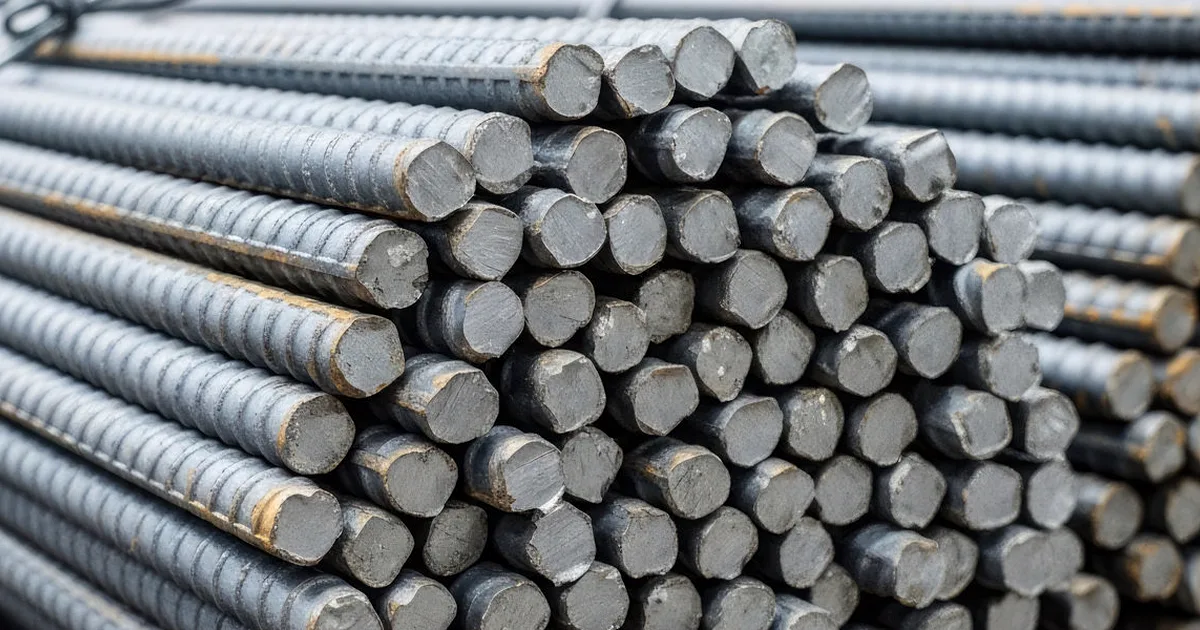
Rebar is bought by the ton and installed by the meter and the bar, and between the purchase unit and the installation unit stands one equation everyone who has worked in contracting knows: diameter squared ÷ 162. In this guide we derive this rule from its physical origin so you know the limits of its accuracy, present the standard diameter weight table, and work a full example from bar bending schedule lengths to a commercial bar order — the same calculations the Adawati Rebar Weight Calculator performs.
Deriving the rule: from steel density to ÷ 162
The weight of any bar = its volume × its density. And steel density is known: 7850 kg/m³. The volume of one meter of a bar with diameter d millimeters = its circular section area × 1 meter = (π ÷ 4) × (d ÷ 1000)² × 1. Substituting and simplifying gives the weight per meter in kilograms:
Weight per meter (kg/m) = diameter² × 0.00617 ≈ diameter² ÷ 162 — because the reciprocal of 0.00617 equals about 162.
So the rule is not professional magic but an arithmetic shortcut precise enough for purchasing and bills of quantities. Its accuracy is limited by manufacturing tolerances: the bar's actual diameter may be slightly less or more than its commercial name, so the real weight moves around the rule's result by a small percentage — which is why large shipments are settled by the scale, not by the equation.
The standard diameter weight table
| Diameter (mm) | Weight per meter (kg/m) | Weight of a 12 m bar (kg) |
|---|---|---|
| 8 | 0.395 | 4.74 |
| 10 | 0.617 | 7.40 |
| 12 | 0.888 | 10.66 |
| 14 | 1.208 | 14.50 |
| 16 | 1.578 | 18.94 |
| 18 | 1.998 | 23.98 |
| 20 | 2.466 | 29.59 |
| 22 | 2.984 | 35.81 |
| 25 | 3.853 | 46.24 |
| 28 | 4.834 | 58.01 |
| 32 | 6.313 | 75.76 |
This is the standard table displayed in the calculator itself. Note that some values differ in the third digit from the direct rule result (for diameter 16 the rule gives 1.580 while the table gives 1.578); the standard tables are built on the precise density with their own roundings. The difference has no practical effect on a purchase order, but do not be surprised by a difference in the last digit between two reliable sources.
A full numeric example: from the bar bending schedule to the order
Let us assume your project's bar bending schedule gives: 16 mm diameter: 30 bars of 7 meters length. And 12 mm diameter: 50 bars of 5.5 meters length. And a cutting waste percentage of 5%:
- Diameter 16: total length = 30 × 7 = 210 meters × 1.580 = 331.9 kg. And the number of commercial bars = (210 × 1.05) ÷ 12 = 18.4 → 19 bars.
- Diameter 12: total length = 50 × 5.5 = 275 meters × 0.889 = 244.4 kg. And the number of bars = (275 × 1.05) ÷ 12 = 24.1 → 25 bars.
- Total net weight = 331.9 + 244.4 = 576.3 kg, and with 5% waste = 605 kg ≈ 0.61 tons — which is your total order figure, distributed over 19 bars of diameter 16 and 25 bars of diameter 12.
Note two methodological details in this example: the number of bars was calculated for each diameter separately, because a commercial bar does not divide between diameters, and the rounding was always up, because fractions are not sold. Whoever adds all the lengths together and then divides once gets a bar count lower than the real one and discovers the shortfall during cutting.
Cutting waste: where does the lost steel go?
The commercial bar is 12 meters long, and your design lengths are rarely multiples of it. A bar cut into two 5-meter pieces leaves two meters; either you find them a place in short elements — stirrups, chairs, short distribution bars — or they become actual waste. That is why realistic waste ranges between 3 and 7% depending on the quality of the bar bending schedule: a smart schedule distributes the cuts over the bars so that the remainders complement each other, while a random one piles them up as scrap. Practical advice: before approving the order, review with your steel fixer or your engineer the largest expected remainders and ask where they will be used; reusing them may lower your percentage by a degree or two.
Fundamental note: the calculator and this guide only convert lengths and counts into weights and purchase orders; determining the diameters, counts and lengths themselves is structural design issued exclusively by a structural engineer through an approved bar bending schedule. Do not infer the reinforcement of any element — footing, column or slab — from educational examples or from circulating approximate ratios.
Common mistakes when calculating steel weight
- Adding lengths of different diameters in one division: the bar count is calculated for each diameter independently, always.
- Forgetting lap lengths and bends: the lengths entered into the calculator must be the actual bar lengths from the bar bending schedule, including lap splice lengths and bend lengths, not the element's net dimensions from the drawing.
- Entering the diameter in centimeters or the length in millimeters: the rule works in millimeters for the diameter and meters for the length; one wrong unit multiplies the result by a hundred or divides it by it.
- Rounding down on the bar count: 18.4 bars means 19 at the steel store, and 18 means cutting stops in the middle of the element.
- Deleting waste to make the order look cheaper: the theoretical weight does not cut itself; the remainders are a physical reality you will pay for as a supplementary order or as scrap.
On receiving the shipment: how do you verify that what arrived is what you ordered?
Your precise calculation loses its value if the receipt does not match it. Three quick steps when the truck arrives protect your order: first, counting for each diameter separately and matching it with the bar count in your order (19 and 25 in our example), not by the total weight alone; a correct total weight may hide a swap between diameters. Second, weighing a sample: choose one or two bars from each diameter, measure their actual length, and compare their weight with the table weight (the 12 m bar for diameter 16 is about 18.94 kg); a small deviation is natural, but a large repeated deviation deserves a pause with the supplier before full unloading. Third, visual inspection: light surface rust is common and usually harmless, but deeply flaked bars, bent bars, or bars with differing ribs among themselves are a sign of mixed batches or sources. And document the receipt with a photo of the shipment and a receipt stating the diameters, counts and weights, and keep it with the bar bending schedule; these three papers are your reference in any later dispute with the supplier or the contractor over the structure quantities.
Finally, plan the steel storage on site before it arrives, not after: bars raised off the ground on wooden beams, covered from direct rain if their stay is long, and separated by diameter with clear labels. Steel stored on wet soil for weeks rusts in a way that contaminates the concrete and weakens the bond, and steel of mixed diameters without labels turns cutting day into a wasted sorting day.
Stirrups and small diameters: the forgotten item in every order
When the owner calculates his project's steel, he automatically thinks of the long main bars — the reinforcement of footings, columns, beams and slabs — and forgets a whole category that consumes a weight not to be underestimated: stirrups and secondary bars with diameters of 8 and 10 mm, which wrap around columns and beams at close intervals so that their lengths accumulate to hundreds of meters in a medium villa. These lengths exist in the bar bending schedule if it is complete, but they are the first to fall out of quick manual calculations. So always compare your order's weight with the bar bending schedule's weight, item by item, not in total only; if your schedule includes the stirrups and your order does not include them, the shortfall will appear in the middle of fixing the columns, and a supplementary order for a small diameter costs transport and delay far beyond its weight.
Conclusion
Your project's steel weight = for each diameter separately: (number of bars × their length × diameter² ÷ 162), then a realistic cutting waste, then converting the lengths into commercial bars of 12 meters with rounding up. Perform it on your bar bending schedule in the Rebar Weight Calculator — a row for each diameter, up to ten rows — and print the result as a purchase order distributed by diameter, then link the weight to your concrete volume from the Concrete Calculation Guide to complete the structure bill of quantities.